A note from our founder: Celebrating Jo’s 1,000th class on Glo, and the first teacher yes that helped make Glo possible.
By Derik Mills
In early 2008, after one of Jo Tastula’s classes in Manhattan Beach, I asked if I could share an idea with her. Glo wasn’t Glo yet. YogaGlo.com didn’t exist.
I had been taking Jo’s classes regularly in Manhattan Beach, California. I first found her teaching not long after moving from New York City to Los Angeles in 2005, at a time in my own life when I needed exactly the kind of space she creates. Her classes were grounding, precise, and quietly profound without announcing themselves as profound. Something in her teaching invited my body to understand: now is the time to take care of myself. Now is a moment to feel.
After class, we walked toward the Manhattan Beach pier, and I tried to explain a dream I could not stop thinking about.
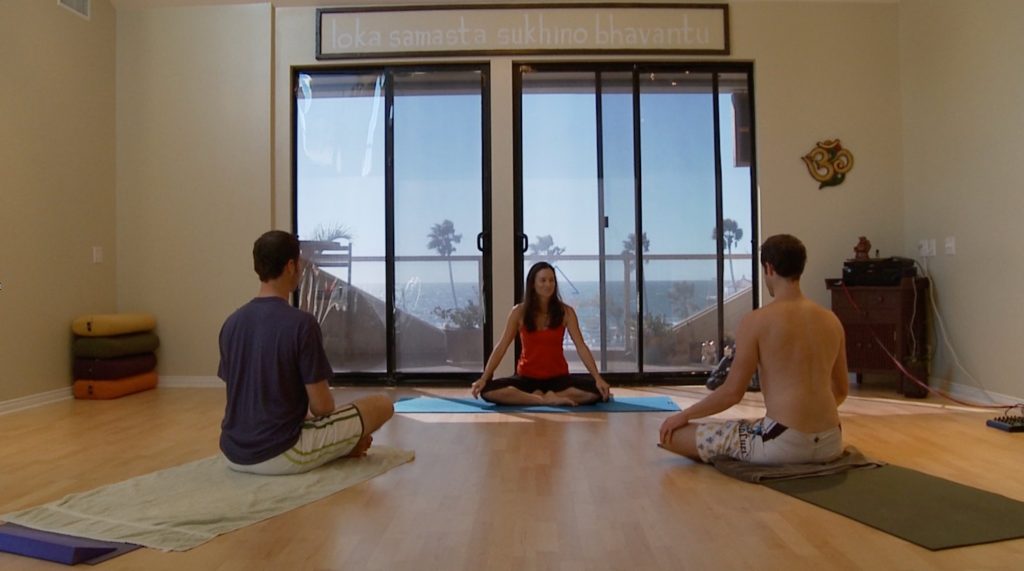
The dream had started nearly a year earlier in 2007, when I was sitting in traffic, late to a yoga class and frustrated. I had a thought that would not leave me alone: why can’t I beam this class into my living room? Not a slick, staged version of it. Not yoga as performance. I wanted to feel as though I was in the real class: a real teacher, real students, people breathing and wobbling and struggling to hold a pose, all practicing together.
What I was trying to build wasn’t convenience. It was access to a certain kind of presence — I just didn’t have the language for it yet.
That was the idea I shared with Jo on the pier. I was nervous. I was already all in: savings committed, the technology underway, no turning back. Still, I knew it was an experiment. I knew there was no guarantee it would work.
What I did not fully understand at the time was that Jo was hearing the idea through her own life experience. She had grown up in remote Western Australia, where access to teachers, services, and conveniences could not be taken for granted. Years later, when we spoke on The Glo Podcast, she told me that the idea of having your favorite yoga teacher with you, no matter where you were, “seemed very logical.” So while I was bracing for skepticism, Jo was already leaning yes.
Before there was a platform to launch into the world, there had to be trust. Jo gave us that.
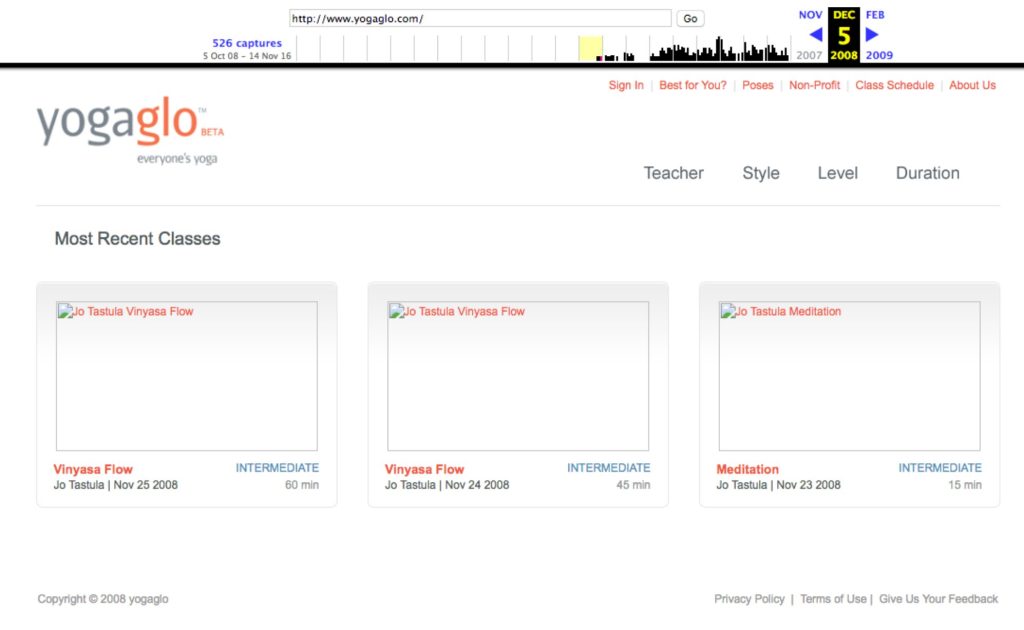
In November 2008, we posted our first three classes on YogaGlo.com. In those earliest days, it really was as humble as it sounds: Jo, Ryan, me, and a little camera, trying to figure out where everyone should stand and what this new thing might become. Jo once described those beginnings as “cute,” “sweet,” and “humble.” I do too, along with the full spectrum of emotions that come with creating. We had time to fumble, to learn, and to build a foundation.
Today, Jo’s 1,000th class on Glo goes live.
I have been thinking about what it takes to teach 1,000 classes. The number is impressive in the abstract, but in practice it is something else. It is preparation, yes. It is craft. It is the discipline of returning to the mat, fully, whether or not anyone is watching. It is 1,000 invitations to people in living rooms, hotel rooms, hospital rooms, and quiet corners of homes all over the world. It is 1,000 moments when Jo showed up thoroughly prepared, present, innovative, and willing to meet people wherever they were.
Over those years, Glo moved from YogaGlo to Glo. Jo moved through pregnancy, motherhood, inquiry, healing, and renewal. Through all of it, she kept returning to the mat and inviting others to do the same.
When Jo and I spoke on the podcast, I tried to name what I have always felt in her classes. Her sequencing is meticulous, but the deeper quality is harder to describe: Jo’s teaching never feels like it is about Jo. It feels like she is in service of the present moment.
Jo said something in that conversation that I have carried with me:
“I think of myself as a friend. I’m not on a pedestal of any kind. I’m not an authority. When I invite people into my space, it’s a journey we take together.”
She also said that modern life gives us endless invitations to think but far fewer invitations to feel. Her work, as she described it, is not to tell students what they should experience. Her work is to welcome what is already there. “Welcome you in your experience,” she said, “and everything that you’re feeling. None of it is wrong.”
That is a rare kind of teaching. It is one of the many reasons people return to Jo’s classes year after year. They are entering a space where they can listen inwardly, move honestly, and remember something about themselves.
Near the end of our podcast conversation, Jo offered one of the most beautiful definitions of yoga I have heard. She said yoga is intimacy with this moment, as it is right now. A giving and receiving. A way of being with life without immediately trying to reconstruct it, water it down, or get in the way.
That is what Jo has offered Glo’s community for 1,000 classes: intimacy with this moment. The ordinary ones and the devastating ones. The joyful ones and the uncertain ones. Again and again, she has helped people meet themselves without making them feel wrong for what they find.
Jo, thank you for the first yes on the pier in 2008, and for every yes, every honest exchange, every recalibration since. Thank you for trusting the experiment before any of us knew what it would become. Thank you for helping set the foundation for Glo. Thank you for 1,000 classes, and for the kind of teaching that does not ask people to become someone else before they begin.
I’m so grateful, and so honored, to have been working with you all this time.
And I’m excited for what comes next. For the members practicing with Jo right now, and for the ones who haven’t found her yet, who will press play on one of her classes for the first time and feel exactly what so many of us felt the first time. The next thousand classes are already underway.
To the Glo community: please join me in celebrating Jo’s 1,000th class. Take the new class when it drops. Revisit a class that has stayed with you. Or send a quiet thank-you across the airwaves to a teacher who has walked beside so many of us through the slow work of being human.
With gratitude,
Derik